


Preorder- LowCarb Flaxseed Oat Sourdough 1s | Healthy Bread for Everyday Breakfast
Preorder- LowCarb Flaxseed Oat Sourdough 1s | Healthy Bread for Everyday Breakfast



Product Details


LowCarb Flaxseed Oat Sourdough 1 Loaf | Healthy Bread for Everyday Breakfast
Start your morning enjoying the bread you love, without worrying so much about your blood sugar.
With a scientifically tested Low GI of 37, Alpro LowCarb Sourdough stands apart from everyday favourites like white bread (GI 83), fried mee hoon (GI 99) and nasi lemak (GI 66), based on Malaysia's Recommended Nutrient Intakes.
Its Low GI helps support a slower, more gradual rise in blood sugar, while 9.4g of protein and 5.4g of fibre per 2 slices (50g) make it a satisfying breakfast choice that may help you feel fuller for longer.
Because a good morning starts with a breakfast you can enjoy.
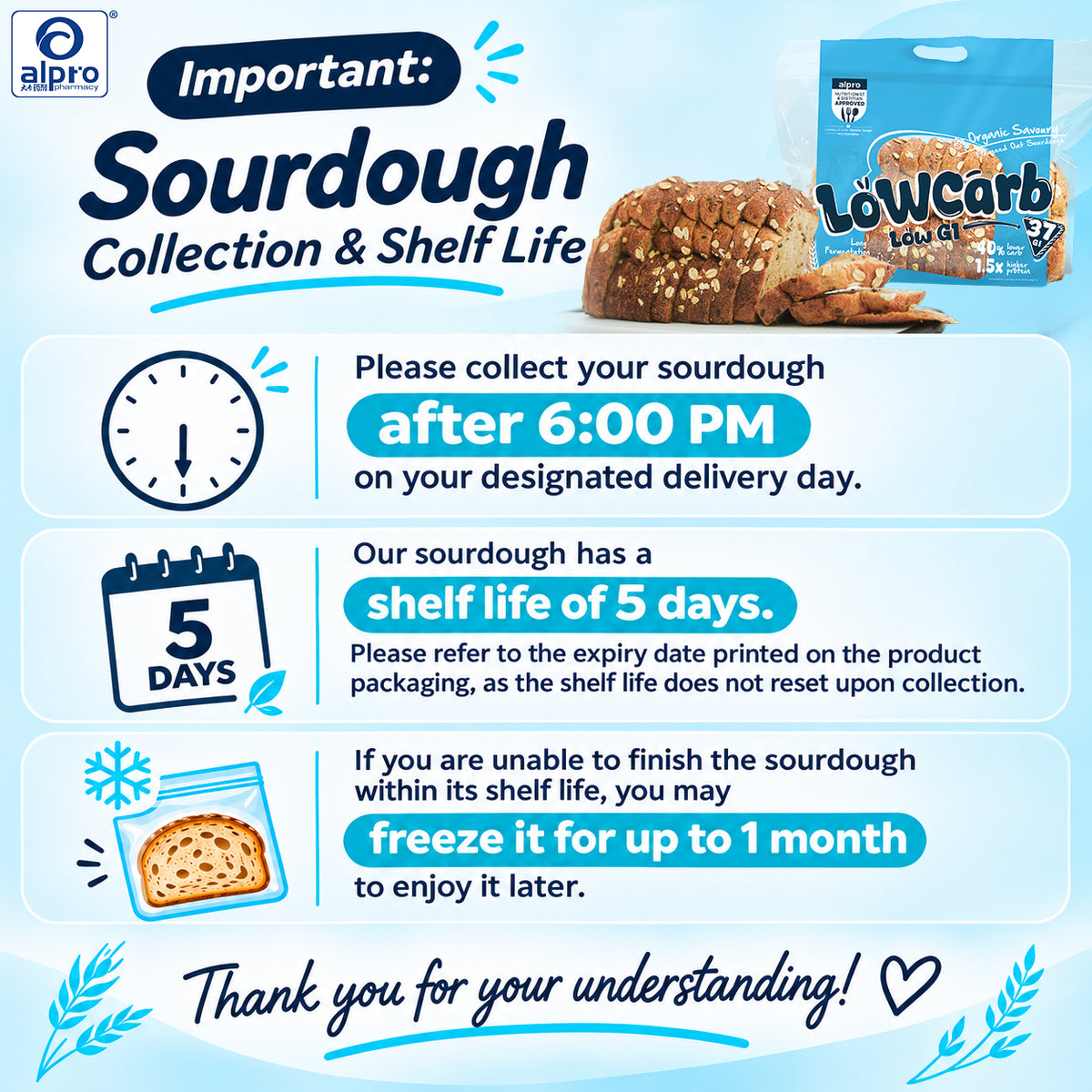
Five-day shelf life and freezer storage guidance
- 5 days after delivery to Alpro Pharmacy Outlets
- Storage: keep fresh in freezer for 1 month
- Reheat: 2-3 mins for toaster, 1 min for microwave
Customer FAQs
1. What makes Alpro LowCarb Sourdough different from regular white bread?
Alpro LowCarb Sourdough contains 18.8g of carbohydrates, 9.4g of protein and 5.4g of dietary fibre per 2 slices (50g). In comparison, regular white bread contains approximately 29.64g of carbohydrates per 2 slices (57g), according to the Malaysian Food Composition Database (MyFCD) [3]. With a scientifically tested Low GI of 37, Alpro LowCarb Sourdough offers a nutritious alternative for those looking to manage their carbohydrate intake.
2. Is sourdough bread low in carbohydrates?
Not all sourdough bread is low in carbohydrates. Regular sourdough contains approximately 23.7g of carbohydrates per 50g, according to the Singapore Food Composition Database [4]. In comparison, Alpro LowCarb Sourdough contains 18.8g per 2 slices (50g). For reference, 2 slices (57g) of regular white bread contain 29.64g of carbohydrates, according to the Malaysian Food Composition Database (MyFCD) [3].
3. How many carbohydrates are in Alpro LowCarb Sourdough?
Two slices (50g) of Alpro LowCarb Sourdough contain 18.8g of carbohydrates. In comparison, two slices (57g) of regular white bread contain approximately 29.6g of carbohydrates, according to the Malaysian Food Composition Database (MyFCD) [3].
4. What is the Glycaemic Index (GI) of Alpro LowCarb Sourdough?
Alpro LowCarb Sourdough has a scientifically tested Glycaemic Index (GI) of 37, placing it in the low-GI category (GI ≤55) [5]. Low-GI foods generally cause a slower, more gradual rise in blood sugar compared to high-GI foods. However, portion size still matters, especially for people managing diabetes.
Scientific reference: [1]
5. Has the Low GI of Alpro LowCarb Sourdough been scientifically proven?
Yes! A study published on 23 July 2024, titled Glycemic Index Evaluation of Flaxseed Oats Sourdough Bread, tested the bread's effect on blood sugar in 10 healthy adults aged 23–37.
Participants consumed the bread and a glucose reference drink on separate occasions, with their blood sugar measured over 2 hours to calculate the Glycaemic Index (GI).
The published study reported a GI of 37.3, commonly rounded to GI 37, confirming that Alpro LowCarb Sourdough falls within the low-GI category.
The study was conducted in healthy adults without diabetes, so individual blood sugar responses may vary.
Want to Know More? Explore the Published Research!
Published study: International Journal of Nutrition and Food Sciences (23 July 2024).
DOI: 10.11648/j.ijnfs.20241304.12
Read the research: https://doi.org/10.11648/j.ijnfs.20241304.12
6. What ingredients are used in Alpro LowCarb Sourdough?
Alpro LowCarb Sourdough is made with ingredients including oats and flaxseeds, contributing to its high-fibre and high-protein nutritional profile. For the complete ingredient list, please refer to the product packaging.
7. Does Alpro LowCarb Sourdough contain artificial preservatives or additives?
Alpro LowCarb Sourdough is made without added artificial preservatives, colours, flavours, softeners or bread improvers. It is crafted with ingredients such as wholemeal wheat flour, oats, flaxseeds and wheat sourdough.
8. Is Alpro LowCarb Sourdough suitable for people with diabetes?
Yes, Alpro LowCarb Sourdough can be included in a balanced meal plan for people with diabetes. With a low GI of 37 and 40% fewer carbohydrates compared to regular white bread [3], it offers an alternative for those managing their blood sugar. However, portion sizes and individual blood sugar responses still matter.
9. What is the difference between low-carb bread and low-GI bread?
Low-carb bread contains fewer carbohydrates compared to conventional bread, while low-GI bread has a glycaemic index (GI) of 55 or below, meaning it generally causes a slower, more gradual rise in blood sugar compared to high-GI bread [5].
Alpro LowCarb Sourdough offers both benefits, with fewer carbohydrates than regular white bread based on the Malaysian Food Composition Database (MyFCD) [3], and a scientifically tested low GI of 37 [1].
10. Does low-GI bread raise blood sugar?
Yes. Low-GI bread still contains carbohydrates and can raise blood sugar, but generally produces a slower, more gradual rise compared to high-GI bread [5]. Alpro LowCarb Sourdough has a scientifically tested GI of 37 [1], making it a low-GI option. Portion size still matters, especially for people managing diabetes.
11. Is sourdough bread easier to digest?
Sourdough fermentation helps break down certain components of flour, which may make sourdough bread easier to digest for some people. However, the benefits may vary from person to person, depending on individual digestive tolerance. [6]
12. Is Alpro LowCarb Sourdough suitable for children and older adults?
Yes. Alpro LowCarb Sourdough can be enjoyed by both children and older adults as part of a balanced diet. Made with oats, flaxseeds and wholemeal wheat flour, it provides protein and dietary fibre. For a balanced diet, enjoy it alongside a variety of foods, including vegetables, fruits and protein sources, to meet daily nutritional needs. Portion sizes should be adjusted according to individual dietary requirements.
13. How much low-carb bread can I eat in one meal?
The appropriate portion depends on your individual carbohydrate needs and health goals. Two slices (50g) of Alpro LowCarb Sourdough contain 18.8g of carbohydrates. For a balanced meal, pair the bread with protein-rich foods such as eggs and vegetables, following the Malaysian Healthy Plate (Suku-Suku-Separuh) guidelines [7].
14. How long does Alpro LowCarb Sourdough stay fresh?
Alpro LowCarb Sourdough stays fresh for up to 5 days at room temperature, up to 1 week in the refrigerator, or up to 1 month in the freezer when stored properly. For the best quality, freeze the bread early and thaw only what you need.
15. How do I reserve a loaf of Alpro LowCarb Sourdough?
Simply contact your nearest Alpro Pharmacy outlet to check availability and reserve your loaf. Our sourdough is delivered fresh every week, so you can arrange your collection according to your outlet's delivery schedule.
References
- Glycemic Index Evaluation of Flaxseed Oats Sourdough Bread. (2024). International Journal of Nutrition and Food Sciences. https://doi.org/10.11648/j.ijnfs.20241304.12
- National Coordinating Committee on Food and Nutrition. (2017). Recommended nutrient intakes for Malaysia: A report of the Technical Working Group on Nutritional Guidelines. Ministry of Health Malaysia. https://hq.moh.gov.my/nutrition/wp-content/uploads/2023/12/FA-Buku-RNI.pdf?
- Ministry of Health Malaysia. Malaysian Food Composition Database (MyFCD): White Bread. https://myfcd.moh.gov.my/myfcd97/index.php/site/detail_product/101051/0/10/white%20bread/0/0/
- Health Promotion Board Singapore. Singapore Food Composition Database (SG FoodID): Sourdough Bread. https://pphtpc.hpb.gov.sg/web/sgfoodid/tools/food-search/details/F05030020
- Peres, M., et al. (2023). The Health Effects of Low Glycemic Index and Low Glycemic Load Interventions on Prediabetes and Type 2 Diabetes Mellitus: A Literature Review of RCTs. Nutrients, 15(24), 5060. https://doi.org/10.3390/nu15245060
- Does sourdough bread provide clinically relevant health benefits? (2023). Frontiers in Nutrition. DOI: [https://doi.org/10.3389/fnut.2023.1230043
- Ministry of Health Malaysia. (2020). Malaysian Dietary Guidelines 2020. National Coordinating Committee on Food and Nutrition (NCCFN), Ministry of Health Malaysia. https://hq.moh.gov.my/nutrition/wp-content/uploads/2024/03/latest-01.Buku-MDG-2020_12Mac2024.pdf
SKU: 100434216

- Choosing a selection results in a full page refresh.
- Opens in a new window.